Pennsylvania Chapter of the American Academy of Pediatrics
  • About Us
    • Board of Directors
    • Mission & History
    • Programs
    • Staff
    • Employment Opportunities
    • Financials and Governance >
      • Governance
    • Contact Us
  • Engagement Opportunities
    • PA AAP Projects/Initiatives- Current >
      • Achieving Chapter Equity (ACE)- Mulitilingual Literacy
      • Healthy Mental Development
    • PA AAP Projects/Initiatives- Additional
    • Committees >
      • Advocacy Committee
      • Children & Youth with Special Health Care Needs (CYSHCN) Committee
      • Climate & Environmental Health Committee
      • Diversity, Equity & Inclusion Committee
      • Early Childhood Committee
      • Educational & CME Planning Committee
      • Foster & Kinship Care Committee
      • Governance Committee
      • Infant Safe Sleep Committee
      • School Health Committee
    • Programs >
      • Breastfeeding Programs
      • Early Childhood Education Linkage System (ECELS)
      • Healthy Teeth, Healthy Children (HTHC)
      • Pennsylvania Immunization Coalition (PAIC)
      • Pennsylvania Medical Home Program (PA MHP)
      • Suspected Child Abuse & Neglect (SCAN)
      • Traffic Injury Prevention Project (TIPP)
  • Advocacy
    • Become a PA AAP Advocate
    • Advocacy Action Center (PA AAP Members Only)
    • Blueprint for Children
    • Pennsylvania Children's Outdoor Bill of Rights
  • Resources
    • For Providers >
      • Diversity, Equity, and Inclusion Toolkit
      • Firearm Safety Toolkit for Healthcare Providers
      • Get Out the Vote 2024
      • Healthy Mental Development
      • Immigrant Health
      • Infant Safe Sleep
      • Immunization
      • Multilingual Literacy
      • Pediatrician Kinship Care Toolkit
      • Suicide Prevention Toolkit for Providers
      • WIC
    • For Caregivers >
      • Healthy Mental Development
      • Immigrant Health
      • Infant Safe Sleep
      • Suicide Prevention Toolkit for Caregivers
      • WIC
    • For Youth >
      • Healthy Mental Development
      • Immigrant Health
      • Suicide Prevention Toolkit for Youth
    • Health Updates and Advisories >
      • CDC Health Alerts
      • PA DOH Health Alerts
      • Philadelphia DOH Health Alerts
      • FDA Health Alerts
  • Events
    • Calendar
    • 2026 Pediatric Conference
    • Let's Talk
  • News
  • Awards
Picture
​EPIC®: Food Insecurity joins the PA AAP’s previous programs following the Educating Physicians In their Communities (EPIC®) model of practice-based change. EPIC®: Food Insecurity has three components: a live (in-person or via Zoom) CME/CEU program presented by a physician and a registered dietitian (RD) team, the RD presenting to your presentation connects with a food pantry or food bank in your area, and staff from the food bank or food pantry either participates in the live EPIC® or otherwise communicates to share first-hand how the pantry works so that future referrals from the practice can be well-informed. The live program at your practice is designed to be 1 hour, at a date and time that works for you to maximize physician and staff attendance. Content includes: nature and extent of food insecurity; food insecurity screening; current research and tips on how to screen most effectively; responding to a family who identifies as being food insecure; and up-to-date information about how COVID-19 is affecting WIC, SNAP, and other local food resources. All activities of EPIC®: Food Insecurity are provided at no cost. EPIC®: Food Insecurity is funded by a grant from The Cigna Foundation. 

A live CME/CEU 1 hour EPIC®: Food Insecurity program via Zoom (or in-person when situation permits) presented by a physician and a registered dietitian is available for your staff or Grand Rounds. To schedule, contact us. 
Food Insecurity

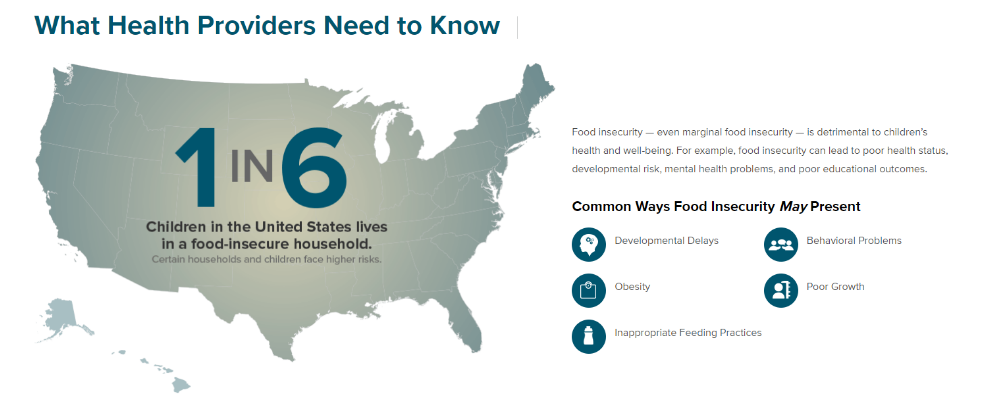
The limited or uncertain access to enough food — is a critical child health issue that impacts children and families in all communities. Unfortunately, one in six U.S. children lives in a food-insecure household. Children who live in households that are food insecure, even at the least severe levels of food insecurity, are likely to be sick more often, recover from illness more slowly, and be hospitalized more frequently

In Pennsylvania

​people are struggling with hunger
​are children
Picture
The American Academy of Pediatrics (AAP) and the Food Research & Action Center (FRAC) jointly released a new toolkit, Addressing Food Insecurity: A Toolkit for Pediatricians, a comprehensive resource on how to identify and address childhood food insecurity.
Download the Toolkit
SCREENING for Food Insecurity
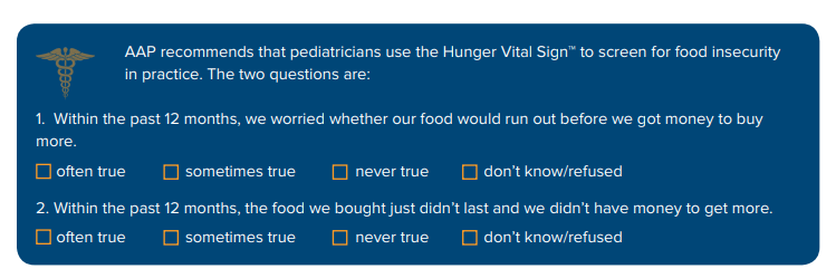
Use the Validated and AAP-Recommended Hunger Vital Sign™ to Screen for Food Insecurity The Hunger Vital Sign™ is a validated two-question food insecurity screening tool. The two questions are drawn from USDA’s 18-question Household Food Security Scale, which is the “gold standard” for food security measurement and used primarily for surveillance and research purposes. The Hunger Vital Sign™ provides a more practical tool for use in clinical settings and in community outreach. The screening tool was validated by Children’s HealthWatch researchers.
Picture
Help is available for your family or patients – find resources using the links and information here:
Educate and Train Staff
Schedule Regular Screenings
Add Screening to Workflow
Screening Sensitivity
Interventions to address food insecurity in health care settings will vary by community needs, and the goals and capacity of the partner organizations. Here are some tips as to how you can start to address food insecurity amongst your patients:
​
  • Screen patients for food insecurity while they are in the health care setting; 
  • Research resources in your community; 
  • Refer those patients and their families to food bank agencies and programs to connect patients with healthy food access as well as application assistance for SNAP and other long-term nutrition supports
  • Create new food distribution programs in the health care facility when there is sufficient need, interest, and capacity, and/or existing community resources are insufficient;
    • Penn State Produce Rx
    • CHOP Food Pharmacy
    • Mobile Food Pantry 
  • Advocate for programs and policies that support anti-hunger related legislation
    • More Advocacy Resources:
      • ​FRAC
      • Bread for the World​
  • Check out more provider resources:
    • DHS Blueprint for hunger
    • Short Videos from AAP

Find more national and statewide resources on our comprehensive EPIC: Food Insecurity Resource List.

Download Resource List
What can you do when a patient screens positive for food insecurity?
Apply for federal nutrition programs for infants, children, and adolescents available in every state: 
​Supplemental Nutrition Assistance Program (SNAP)
For more than 40 years, SNAP has served as the foundation of America’s national nutrition safety net. It is the first line of defense against hunger and is a powerful tool for improving nutrition among low-income people. Benefits come to the household via electronic debit cards, known as Electronic Benefit Transfer (EBT) cards which can be used in more than 246,000 approved retail stores nationwide to purchase food. Eligibility is based on financial factors such as income and expenses available to the household, as well as immigrant status.
​
For more information about SNAP, visit:
  • USDA/Food and Nutrition Service
  • PA/Department of Public Welfare
  • COMPASS: Access to Health and Human Services
The National School Lunch Program and School Breakfast Program (SNAP)
The National School Lunch Program is a federally assisted meal program operating in over 100,000 public and non-profit private schools and residential child care institutions. Any child at a participating school may purchase a meal through the National School Lunch Program. Children from families with incomes at or below 130 percent of the poverty level are eligible for free meals. Those with incomes between 130 percent and 185 percent of the poverty level are eligible for reduced-price meals, for which students can be charged no more than 40 cents.

The School Breakfast Program is a federally assisted meal program operating in public and non-profit private schools and residential child care institutions. At the State level, the program is usually administered by State education agencies, which operate the program through agreements with local school food authorities in more than 89,000 schools and institutions. The School Breakfast Program operates in the same manner as the National School Lunch Program. For more information about the National School Lunch Program and the Breakfast Program, visit: USDA/Food and Nutrition Service.

APPLY ONLINE
Special Supplemental Nutrition Program for Women, Infants and Children (WIC)
WIC provides nutritious foods, nutrition education (including breastfeeding promotion and support), and referrals to health and other social services to participants at no charge. WIC serves low-income pregnant, postpartum and breastfeeding women, and infants and children up to age 5 who are at nutrition risk. To be eligible on the basis of income, applicants’ income must fall at or below 185 percent of the U.S. Poverty Income Guidelines. A person who participates or has family members who participate in certain other benefit programs, such as the Supplemental Nutrition Assistance Program (SNAP, formerly Food Stamps), Medicaid, or Temporary Assistance for Needy Families (TANF), automatically meets the income eligibility requirement.

For more information about WIC:
  • USDA/Food and Nutrition Service
  • Pennsylvania WIC – Online
  • Phone: 1-800-942-9467
    ​
SIGN UP FOR WIC
The Emergency Food Assistance Program (TEFAP)
TEFAP is a Federal program that helps supplement the diets of low-income Americans, including elderly people, by providing them with emergency food and nutrition assistance at no cost. Through TEFAP, the USDA purchases USDA foods and makes them available to State Distributing Agencies. States provide the food to local agencies that they have selected which in turn distribute the food to local organizations that directly serve the public, such as soup kitchens and food pantries. States also provide the food to other types of local organizations, such as community action agencies, which distribute the foods directly to low-income households. Each state is responsible for setting its own eligibility requirements.

For more information about TEFAP, visit:
  • USDA/Food and Nutrition Service
  • PA Department of Agriculture

To access TEFAP foods, contact the TEFAP Lead Agency Program Coordinator in your County.
​
COUNTY LEAD AGENCY DIRECTORY
Commodity Supplemental Food Program (CSFP)
CSFP provides commodity food packages for low-income pregnant and breastfeeding women, other new mothers up to one year postpartum, infants, children up to their sixth birthday, and elderly persons at least 60 years of age who meet income eligibility requirements. CSFP food packages do not provide a complete diet, but rather are good sources of the nutrients typically lacking in the diets of the target population.

When CSFP was initially introduced, it primarily served low-income pregnant and postpartum women and their young children. Over the years, however, as this population has become increasingly served by WIC and the senior population has grown, senior participation has grown significantly. For elderly persons, eligibility for the program is limited to those with income at or below 130 percent of the poverty level.

Get more information about CSFP
  • USDA/Food and Nutrition Service
  • PA Department of Agriculture
    ​
To find out if CSFP is available in your area of the State, call 800-468-2433, or send an email to [email protected]
Summer Food Service Program
Programs that operate during the summer when school is not in session and provide congregate nutritional meals (breakfasts, snacks, lunches and/or dinners) for children and youth. Summer food service programs are generally available to youth age 18 and younger who live in designated low-income areas; and may be federally-funded or funded by other entities.
​
Find a summer food service program
After School Meals Program
The After School Meals Program is designed to offer a nutritious meal to students enrolled in an after school program.

Schools that wish to participate in the After School Meals Program must meet the following requirements:
  • The meal must be served after a regular school day.
  • The After School Meals program must include educational and/or enrichment activities.
  • The program provider and cafeteria staff must complete the annual required training.

Apply for After School Meals Program
Child Food Care Program (CAFCP)
The Child and Adult Care Food Program (CACFP) reimburses child and adult care institutions and family or group day care homes for providing nutritious meals and snacks to the children and older adults or chronically impaired persons with disabilities in their care.
​
Childcare providers apply here
If you need food help today, you may also call the National Hunger Hotline. Hotline staff can help you find food near where you live:
  • By Phone:  Call the USDA National Hunger Hotline, which operates from 7:00 AM – 10:00 PM Eastern Time.  If you need food assistance, call 1-866-3-HUNGRY or 1-877-8-HAMBRE to speak with a representative who will find food resources such as meal sites, food banks, and other social services available near your location.
  • By Text: Text “97779” to the automated service with a question that may contain a keyword such as “food,” “summer,” “meals,” to receive an automated response to resources located near an address and/or zip code.
National Food Organizations
Picture
Feeding America →
Picture
Mazon →
Picture
No Kid Hungry →
Picture
National Farm to School Network →
Pennsylvania Food Resources
  • ​​Central Bucks County Food Resources - A list of free food resources in Central Bucks County compiled by Melissa Altman-Traub, MS, RDN, LDN.
  • Central PA Food Bank - Supports more than 1,000 partner agencies and programs throughout their 27-county service area.
  • Feeding Pennsylvania - A partnership formed among eight of Pennsylvania's Feeding America member food banks to advocate for hunger relief across the state.
  • Greater Philadelphia Coalition Against Hunger - Provides maps of local food pantries with information about hours, requirements, and more.
  • Grow Pittsburgh - Supports individual, school and community gardens in the Pittsburgh, PA region.
  • Hunger-Free Pennsylvania - The state’s largest nonprofit provider of food resources for hungry families.
  • ​Just Harvest - Addresses the root causes of hunger in Allegheny County through a focus on economic justice and food access.​
  • ​Philabundance - Delaware Valley's  largest hunger relief organization and member of Feeding America. 
    • ​​​Food Rescue Opportunities​ - Learn how to help reduce food waste.
  • PA DHS - Find a food pantry near you.​
  • Second Harvest Food Bank of Northwest PA​ - Serving Cameron, Clarion, Clearfield, Crawford, Elk, Erie, Forest, Jefferson, McKean, Venango and Warren counties.​
  • The Food Trust - Works with neighborhoods, schools, grocers, farmers and policymakers in Philadelphia and across the country to improve food access.
    • Lankenau Medical Center Partnership - A partnership created to address community health needs by incentivizing healthy food buying using farmer's market coupons called Philly Food Bucks.
    • Power of Produce - Learn about healthy food incentives.
  • UPMC Children's Pediatrics Food Resources - Find food security resources by county for: Allegheny, Beaver, Butler, Cumberland, Dauphin, Erie, Fayette, Mercer, Perry, Washington, Westmoreland, and York. Plus "Statewide" and "Emergency" resources.
    • ​Dining from the Dollar Store - Recipe book with quick and healthy budget-friendly recipes. 
  • Western PA Food Bucks  - Program information and map.
  • York County Food Alliance - A non-profit organization aiming to promote a healthy, sustainable local food system. Find local food resources and specific COVID-19 food resources.
Food Pharmacies
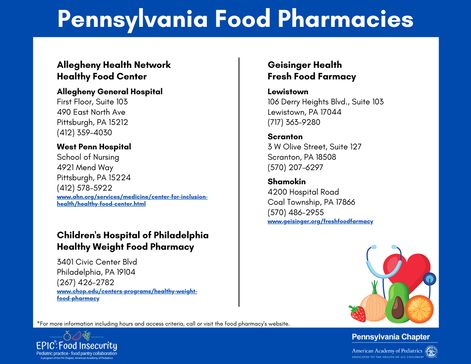
​Food pharmacies are a “food-as-medicine” approach to addressing food insecurity. They provide clinicians with an opportunity to ensure their patients have access to adequate amounts of nutritious food. Patients who screen positive for food insecurity may receive a referral or prescription that enables them to obtain healthy food from the food pharmacy. 

​Use the Pennsylvania Food Pharmacy list to find a food pharmacy location near you. 
Picture
Download the Pennsylvania Food Pharmacy List

PA AAP Food Insecurity Webinar: Let's Talk "Food Insecurity: practical help with effective screening and connecting patients with local resources" 

Picture
View Recording
Recorded: October 16, 2019

Presenter: Dr. Saba Khan, Director, CHOP Food Pharmacies; Attending Physician, The Healthy Weight Program; Attending Pediatrician, Division of General Pediatrics, CHOP Care Network, Norristown, PA; Assistant Professor of Pediatrics, Perelman School of Medicine; and Faculty Scholar, Policy Lab

​Objectives — At the conclusion of the activity, participants should be able to:
  • Utilize the American Academy of Pediatrics (AAP) food insecurity screening tool;
  • Describe 2 work flow processes following a positive response to food insecurity screening; and
  • Identify 2 key aspects of successful referrals to local food security resources.

Let's Talk - "EPIC®: Food Insecurity. Pediatric practice - food pantry collaboration."

Recorded: April 1, 2020

Objectives — This 1 hour CME/CEU program helps Physicians, Nurses, Medical Assistants, Patient Liaisons, Registered Dietitians, other Practice Staff:
  • Recognize the prevalence of food insecurity and its common presentations
  • Identify community resources to help patients access healthy food
  • Recommend effective integration of food insecurity screening and referrals into patient visits
  • Describe ways to partner with food pantries and other community organizations to improve access to food resources

Presenters:
Sharon Cowden, MD, FAAP
Jeanne W. Smith, RD, LDN
​
Access the Let's Talk - EPIC: Food Insecurity webinar online through UPMC's Internet-based Studies in Education and Research (ISER) web portal here. You will need to login or create an account. 

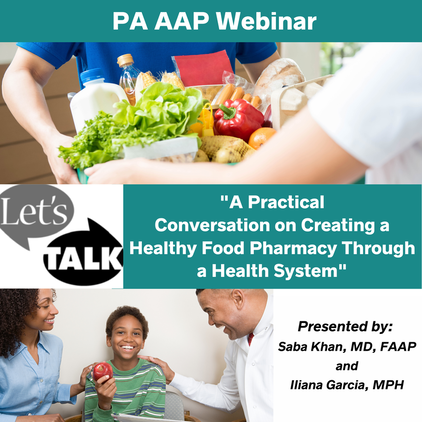
Let's Talk - "A Practical Conversation on Creating a Healthy Food Pharmacy Through a Health System."
Recorded: June 17, 2020

Objectives — As a result of participation in this activity, participants will be able to:
  • Describe 3 possible models for implementing a food pharmacy through a health system
  • Identify 4 stakeholders key to food pharmacy success and ways to engage with each
  • List 3 common challenges to sustaining a food pharmacy and ways to address them

Presenters:   
Saba Khan, MD, FAAP
Iliana Garcia, MHP
Picture
View Recording

Check out PA AAP member, Dr. Joe Barber, discuss Food Insecurity 

Picture
View Recording
Posted: Feb 12, 2020 / 05:40 PM EST / Updated: Feb 12, 2020 / 05:40 PM EST
​
For a number of years, Erie County has been working to address the lack of access to healthy food.
A lack of grocery stores, farmer’s markets, and adequate access to public transportation can lead to what’s called food insecurity.
Pediatrician Dr. Joe Barber stops by the JET 24 Action News Studios to better understand hunger and food insecurity.

Publications on food insecurity:
​

Food Insecurity and Health Care Use
Alon Peltz, Arvin Garg
DOI: 10.1542/peds.2019-0347 | September 9, 2019

Complete Eats: Summer Meals Offered by the Emergency Department for Food Insecurity
Danielle Cullen, Abigail Blauch, Morgan Mirth, Joel Fein
DOI: 10.1542/peds.2019-0201 | September 4, 2019
Food Insecurity on College Campuses
Food insecurity has increasingly become an issue on college and university campuses (Hughes et. al., 2011), and can pose a significant barrier to student success (Johnson, 2011). Understanding that education is the key to getting out of poverty (Beegle, 2003) and/or improving students’ prospects after graduation (US Dept. of Education, 2009).

Needs Assessment
The best comprehensive survey of basic needs insecurity in higher education.

Start a Food Pantry on Campus
The College and University Food Bank Alliance is a helpful resource for starting and running a campus food pantry. The website provides a toolkit for establishing a pantry, a nationwide events calendar, and resource sharing among its over 700 member institutions.
Picture

COVID-19 Food Security Resources and Information 

​Food Insecurity and Local Food Security Resources
Food insecurity has been increasing as a result of the disruptions caused by COVID-19. Prior to the pandemic, 1 in 6 Pennsylvania children was food-insecure, and the numbers have increased. Recent unemployment, transportation restrictions, disruption of school- and college-provided meals, and increased demands on food pantries due to COVID-19 - all have increased food insecurity. 
CAP4Kids: Up-to-date information about resources in the Philadelphia area for children and families. ​https://cap4kids.org/philadelphia/parent-handouts/covid-19-resources/
City of Philadelphia - Food distribution site finder: www.phila.gov/food/#/
Feeding Pennsylvania: A partnership formed among eight of Pennsylvania's Feeding America member food banks to advocate for hunger relief across the state. Find a local food pantry - http://www.feedingpa.org/find-assistance/
Greater Philadelphia Hunger Coalition: Provides maps of local food pantries with information about hours, requirements, and more. http://www.hungercoalition.org
Pennsylvania Department of Agriculture - How to Access Emergency Food Assistance During COVID-19 Mitigation: Provides guidance on how to access emergency food assistance during the COVID-19 pandemic. https://www.agriculture.pa.gov/FoodForThought/Pages/Article.aspx?post=71
Pennsylvania Department of Education - COVID-19 Food Distribution Information for School Communities: Offers information on schools and districts distributing free meals to children. https://www.education.pa.gov/Schools/safeschools/emergencyplanning/COVID- 19/Meals4Kids/Pages/default.aspx
Pennsylvania’s Department of Human Services - Ending Hunger: An online resource for food insecurity in Pennsylvania. http://dhs.pa.gov/ending-hunger/index.htm. Find a local food pantry - https://www.dhs.pa.gov/about/Ending-Hunger/Pages/Food-Pantries.aspx
School Feeding Programs During COVID-19
PA Department of Health- COVID-19 Food Distribution Information for School Communities 
WIC & CHIP Resources
Food Research & Action Center- WIC Waivers and Flexibilites

Learn more about the EPIC®: Food Insecurity Program:

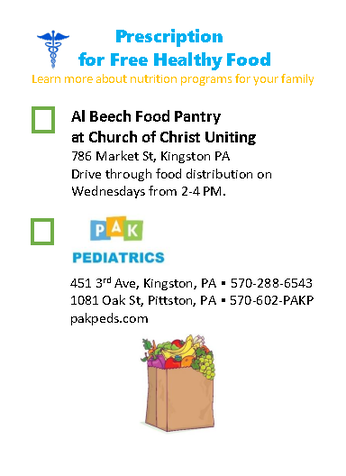
The EPIC®: Food Insecurity program partners primary care practices and food pantries together with the goal of each becoming better educated about the other to promote a screening and referral process that will better serve their clients. We call each of these partnerships a "dyad." The primary care practices are provided with interactive education about the impact of food insecurity on health, effective food insecurity screening, and local food resources that are available for food-insecure patients and their families. The food pantries receive education and resources with an emphasis placed on promoting family health and making healthy food choices. With increased knowledge and awareness on both ends, the collaboration between each primary care practice and food pantry results in the integration of joint nutrition education, strengthening the connection between families and community resources, and increasing access to food.
Picture
Check out this Sample Prescription created by one of our dyads!

© 2025 PA Chapter, American Academy of Pediatrics
661 Moore Road 
Suite 200
King of Prussia, PA 19406
Phone: (484) 446-3000
Fax: (484) 446-3255
This website is a publication of PA AAP and is intended to be a forum for information and communication among the PA AAP membership, individuals and groups interested in the health and well-being of children. Every effort has been made to ensure the accuracy and completeness of the electronic documents and resources provided on this website. However, the PA AAP makes no warranties, expressed or implied, regarding errors or omissions and assumes no legal liability or responsibility for loss or damage resulting from the use of information contained within.
  • About Us
    • Board of Directors
    • Mission & History
    • Programs
    • Staff
    • Employment Opportunities
    • Financials and Governance >
      • Governance
    • Contact Us
  • Engagement Opportunities
    • PA AAP Projects/Initiatives- Current >
      • Achieving Chapter Equity (ACE)- Mulitilingual Literacy
      • Healthy Mental Development
    • PA AAP Projects/Initiatives- Additional
    • Committees >
      • Advocacy Committee
      • Children & Youth with Special Health Care Needs (CYSHCN) Committee
      • Climate & Environmental Health Committee
      • Diversity, Equity & Inclusion Committee
      • Early Childhood Committee
      • Educational & CME Planning Committee
      • Foster & Kinship Care Committee
      • Governance Committee
      • Infant Safe Sleep Committee
      • School Health Committee
    • Programs >
      • Breastfeeding Programs
      • Early Childhood Education Linkage System (ECELS)
      • Healthy Teeth, Healthy Children (HTHC)
      • Pennsylvania Immunization Coalition (PAIC)
      • Pennsylvania Medical Home Program (PA MHP)
      • Suspected Child Abuse & Neglect (SCAN)
      • Traffic Injury Prevention Project (TIPP)
  • Advocacy
    • Become a PA AAP Advocate
    • Advocacy Action Center (PA AAP Members Only)
    • Blueprint for Children
    • Pennsylvania Children's Outdoor Bill of Rights
  • Resources
    • For Providers >
      • Diversity, Equity, and Inclusion Toolkit
      • Firearm Safety Toolkit for Healthcare Providers
      • Get Out the Vote 2024
      • Healthy Mental Development
      • Immigrant Health
      • Infant Safe Sleep
      • Immunization
      • Multilingual Literacy
      • Pediatrician Kinship Care Toolkit
      • Suicide Prevention Toolkit for Providers
      • WIC
    • For Caregivers >
      • Healthy Mental Development
      • Immigrant Health
      • Infant Safe Sleep
      • Suicide Prevention Toolkit for Caregivers
      • WIC
    • For Youth >
      • Healthy Mental Development
      • Immigrant Health
      • Suicide Prevention Toolkit for Youth
    • Health Updates and Advisories >
      • CDC Health Alerts
      • PA DOH Health Alerts
      • Philadelphia DOH Health Alerts
      • FDA Health Alerts
  • Events
    • Calendar
    • 2026 Pediatric Conference
    • Let's Talk
  • News
  • Awards